As an initiative supported by the Ministry of Business, Innovation and Employment (MBIE), TAIAO is committed to promoting and facilitating the adoption of artificial intelligence (AI) and data science in New Zealand's environmental sector.
In this newsletter, you’ll find more information about:
National winners of the AI Hackathon 2026
Spotlight on TuiML
Latest episodes on the Quantum Machine Learning podcast
PAKDD 2027 in Wellington
National winners of the AI Hackathon 2026
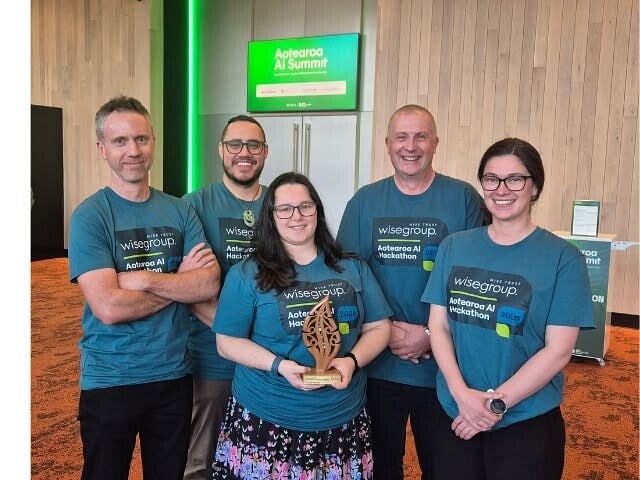
A huge congratulations to the Wise Group team who took out the national final of the Aotearoa Hackathon 2026 with their AI-powered tool that helps Workwise employment consultants support more people with mental health and addiction challenges into meaningful work.
After winning the regional hackathon sponsored by TAIAO and hosted at the University of Waikato, the Wise Group team were one of the top four teams selected from across New Zealand to present at the AI Summit in September where they were the overall winners chosen by the audience.
The team was made up of members from a variety of backgrounds, and their experience showed that with the growth of AI tools you don’t have to be a developer to turn a good idea into something tangible. For a hackathon, the team spent surprisingly little time writing code. Instead, it was their strong belief and passion for the people their solution would support that set them apart and fed into the prototype they developed.
To read more about their solution and their experience during the hackathon, check out our blog post here.
Machine learning for AI Agents
For this month’s newsletter, we wanted to highlight TuiML, TAIAO’s latest tool designed specifically for AI Agents rather than people.
TuiML provides AI agents with a library of tools to use machine learning to train a model, tune it, compare it to the last run, or find an algorithm that fits the data. Researchers can ask their AI agent questions and receive a report presenting the results, letting the agent drive the whole analysis of data. Dr Albert Bifet says that this is where research and development in AI has been heading.
“2025 was the year of the agent and 2026 is the year of building tools for those agents”.
AI agents are autonomous systems that can execute multi-step workflows to achieve a specific goal. With TuiML, those agents can use machine learning methods to find patterns in data and make predictions in a rigorous and reproducible way.
The development of the tool was led by research fellow and Ph.D. candidate Nilesh Verma in collaboration with postdoctoral research fellow Dr Nick Lim and Professors Dr Bifet and Dr Bernhard Pfahringer. Dr Nick Lim says that the goal for TuiML is to lower the barrier of entry for people to use machine learning.
“Previously, researchers would need to generate and run thousands of lines of code to instruct an AI assistant to analyse their data. With TuiML, an AI agent can directly access all of the pre-set algorithms, models and best practice. No coding required. This not only saves tokens (and therefore money!) but means that researchers from different backgrounds can use machine learning to analyse their data and make predictions without needing to spend additional years studying machine learning themselves.”
“Giving agents the tools for machine learning opens a lot of possibilities for data analysis. The TAIAO team are currently exploring applications that range from understanding sediment movement in Ohiwa Harbour, designing more responsive robotic hands for amputees to business forecasting and fraud detection.”
Check out TuiML here: tuiml.ai
New episodes released for the Quantum Machine Learning podcast
Quantum experiments can look convincing on paper. Reproducing them is another story.
In episode 5 of the TAIAO Quantum Machine Learning podcast, Léa Cassé and Sabari Ponnambalam focus on reproducibility, debugging and reliability in quantum workflows.
Léa and Sabari look at what actually goes wrong when quantum workflows move from a clean experiment to repeated runs, different environments and real hardware. They discuss the practical steps needed to determine whether an unexpected result comes from the model, the code or the quantum device itself and discuss what failed runs reveal about the reliability of quantum experiments.
If you haven’t listened yet head to Spotify to find out more and learn what researchers should record, test and control before trusting their results.
PAKDD 2027 in Wellington
Our team are organising the 2027 Pacific-Asia Conference on Knowledge Discovery and Data Mining (PAKDD) in Wellington. TAIAO’s own Heitor Gomes and Albert Bifet will be the general co-chairs and Yun Sing Koh the PC co-chair.
PAKDD is one of the longest established and leading international conferences in the areas of data mining and knowledge discovery. It provides an international forum for researchers and industry practitioners to share their latest developments, new ideas, original research results and practical development experiences from all KDD related areas including data mining, statistical and symbolic machine learning, databases, knowledge acquisition and automatic scientific discovery, data visualization, and knowledge-based systems.
Thanks for reading!
We’ll continue to keep you updated on exciting behind-the-scenes news each month.